Stop Making Sense
Six lenses for seeing past your fastest read, and the exact place where AI belongs.
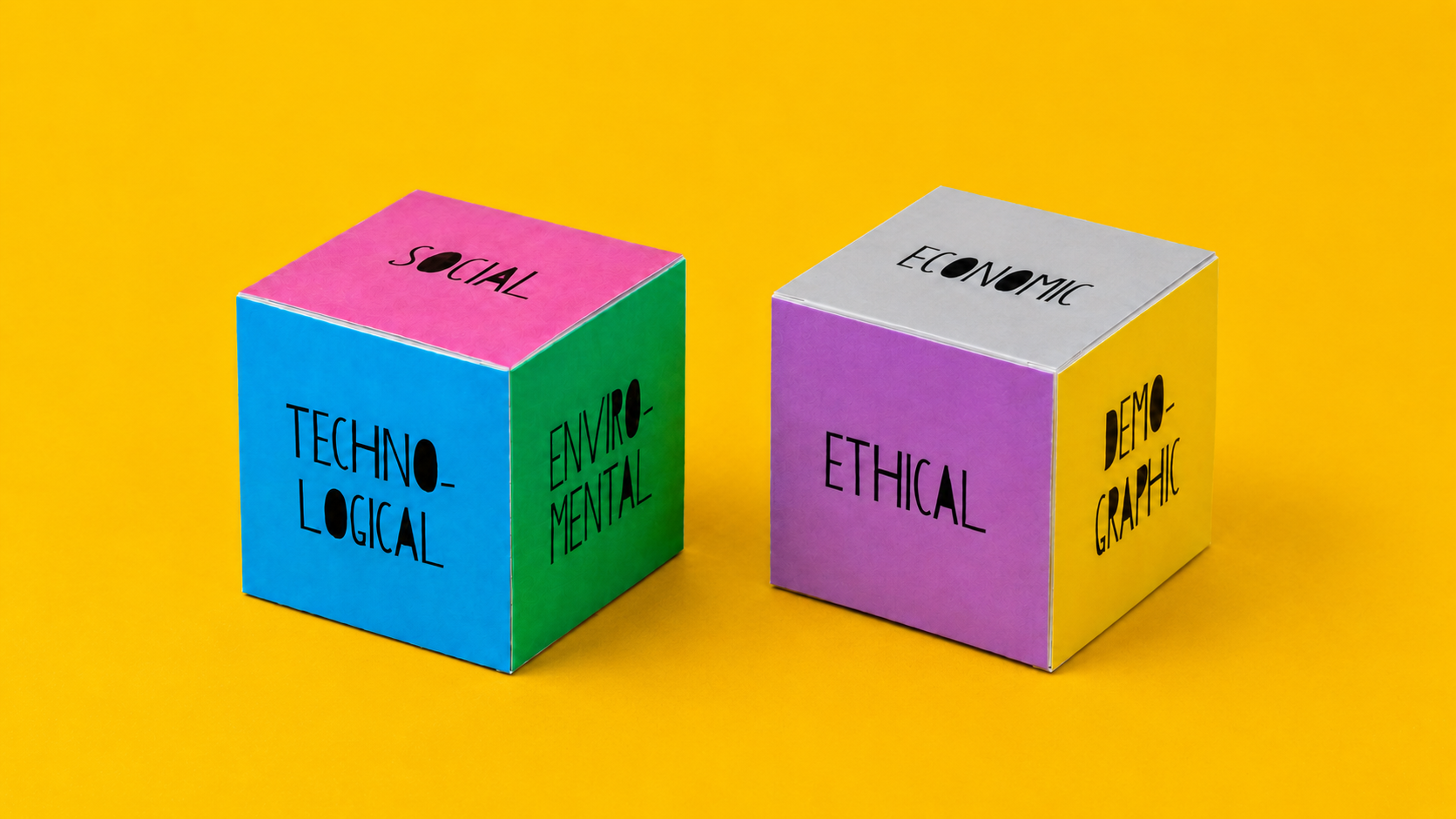
Road to Ventoria drivers of change. © Myriam López
There's real beauty in becoming a senior creative and marketer: enough lived experience to make quick, sound judgments. The main problem with quick, sound judgment is that it shuts the door on curiosity, and with it, innovation.
This is the third and last piece in this series on building Road to Ventoria, a futures-back storytelling game to transform your business. This is the practical one. What follows: changing the lens on instinct, using time, chance, and six drivers of change to imagine futures before bringing them back to a decision made today.
Enter the pigeon lady
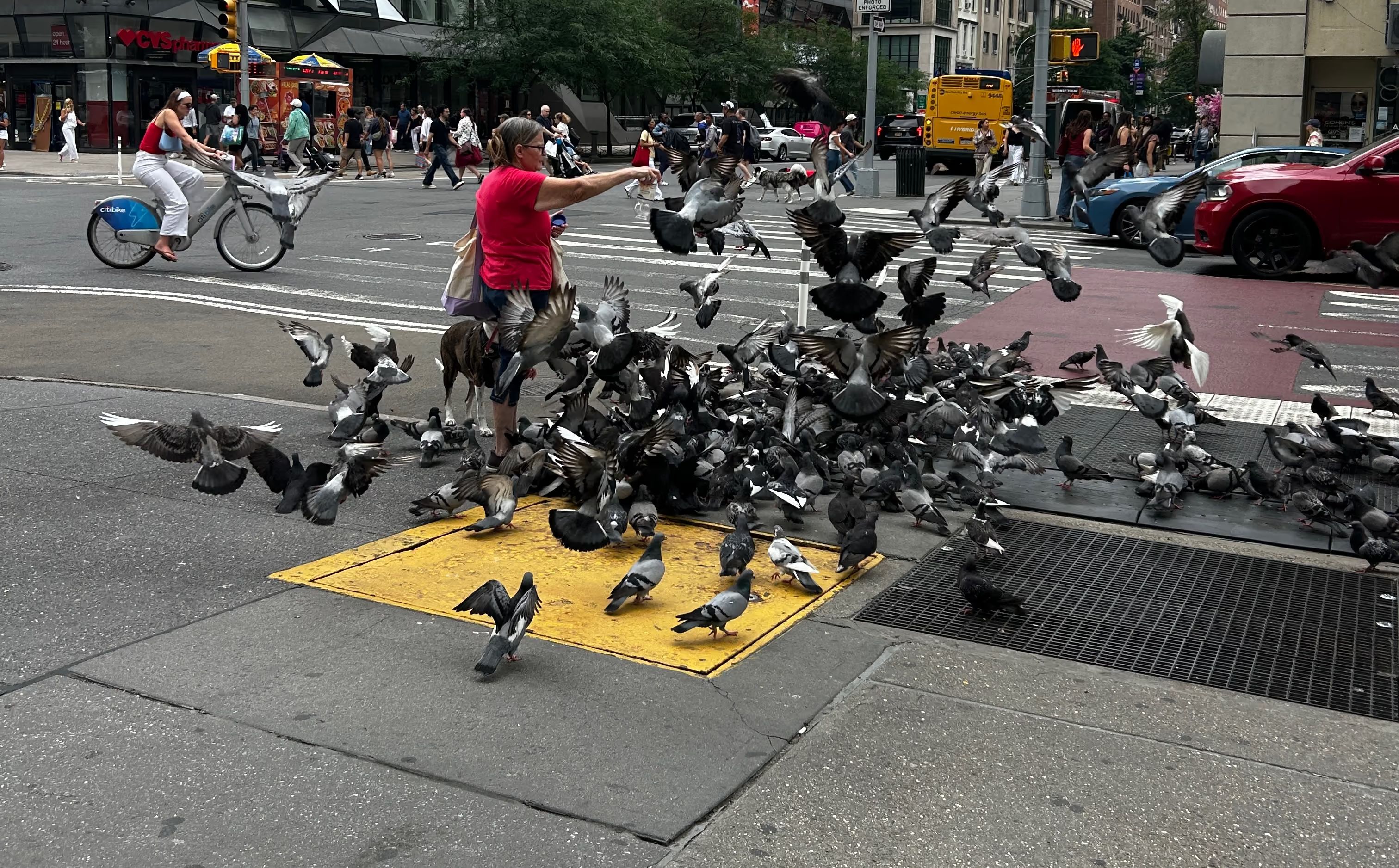
A person feeding pigeons on a traffic intersection. Seen it so often that it becomes invisible. You can walk past her and think: pigeon lady. Or you can stay with the scene for another minute.
Upon observation, you see that she's created a small pause in the middle of the city, and if you look long enough, you start noticing interesting patterns.
The same situation can contain more than one useful angle. Your first read is instinct working fast, and a lens interrupts it long enough for another one to take shape. That's the basic idea behind the six lenses I use in Road to Ventoria.
Let's dig in.
Look at her socially, and maybe she's built a community.
Look technologically, and tracking the pigeons could turn her morning into a map of how birds move through the city.
Look economically, and a bag of birdseed is considerably cheaper than a shrink.
Look environmentally, and the scene becomes a small urban ecosystem instead of a woman surrounded by nuisance birds.
Look demographically, and at seventy-five, this ritual might be part of what keeps her active, connected, and independent.
Look ethically, and the story turns unexpected. Maybe she isn't the harmless pigeon lady at all. Maybe she's quietly doing the population control the city can't be seen doing itself.
Same image. What changed? The lens from which we looked.
As seasoned creatives we tend to see the fix first. That's what the years bought you. A client's objection reads as ignorance dressed as bravado. Silence after a pitch reads as agreement. Sensing a client can't afford you before they've said a word about budget reads as experience.
All three reads are probably right but I'm more interested in what's underneath: new information in the objection, a decision already made in the silence, a blind spot in the instinct.
This is what I want the lenses to provoke in your thinking, before turning to AI.
Where Road to Ventoria comes in
You roll time. You roll a lens. You draw images. You make an instinctive connection and imagine a glimpse of your future. The future has to appeal to you. It's yours. There needs to be something that moves you toward that future.
Getting to an answer has become so easy that the few seconds before you reach for the phone are starting to disappear. Those are the seconds when you look a little longer, hesitate, wonder why something is happening, notice a pattern, or make an odd connection.
Road to Ventoria is built on exactly this delay. It hands you an image blind, a lens you didn't choose, and doesn't let you explain your way out of it. You say what's already happening, what happens if it keeps going, what breaks it, out loud, in your own words.
Once you're happy enough with them, you put pencil to paper. Only on paper can you actually compare the three futures side by side later. Writing in pencil is the closest to "command-Z", and isn't erasing such a pleasurable gesture.
Whatever you're working through, you've probably already tried to solve it with your own instinct. The futures are a storytelling device, built to propel you past that first answer into possibilities instinct alone wouldn't reach. You build three of them this way, one after another, without explaining or analyzing as you go. That's the stop. Only at the end do you look across all three and start making sense of what you made: what keeps recurring, what feels important, what you'd discard. Which future is "right" matters less than what all three reveal together, what you care about, what you're drawn toward, what inspires you.
Then you come back to the present, and answer one question: what decision, made today, moves you toward that future? The future gives you distance from the problem. Coming back gives you something to act on now.
There are no wrong answers, only unexpected possibilities. It's a solo game, but you're not asked to remain yourself. Try on another body, one that doesn't move through the world the way yours does, another set of circumstances, another belief system, another way of being in it. Loosening your own point of view long enough for something unexpected to come through matters more here than speaking for anyone else.
Sharpen the bullet (points)
For a senior creative solopreneur, that decision needs to be concrete enough to change what happens next week, not a vague intention, and not "protect your time" or "don't let scope creep kill you slowly but surely" either. You've heard those a hundred times.
The ethical lens already points at this: maybe she's quietly doing the population control the city can't be seen doing itself. That's only possible because she's invisible and unofficial. Nobody's watching her or holding her accountable, which leaves her free of the liability, politics, and optics that would stop a public servant from doing the exact same thing in the open.
So the chain is: invisible → unaccountable in the way an official would be → free to act where an official couldn't → make your own version of that same freedom / invisibility.
How could you use your perceived invisibility to your advantage? Whatever you decide is also bulletproof (see what I did there?): you can't hit what you can't see.
Where AI fits
No AI during play was a deliberate decision when I designed the game, made by someone who uses AI constantly to the point that, let me be honest, it's becoming a bad habit. A generative tool can do one of two things: substitute for the thought, or put pressure on it. Road to Ventoria only allows the second.
The game trains the way a flight simulator does, building the pilot rather than the flight, because the actual target was always the muscle behind the decision, not the decision itself, and muscles work the way muscles have always worked: use them or lose them. Play enough rounds without a shortcut, and new ways of connecting new dots emerge. Skip the game and ask AI to just tell you, and your brain risks losing the ability to formulate thoughts beyond the prompt.
AI gets useful again once the futures are built, the pattern noticed, the decision made: roast my assumptions, show me the contradiction between the first future and the third, play the skeptical client. Ask the questions, don't answer them.
That's bigger than one game. It's a case for designing tools that protect the part of thinking worth keeping, which happens to be exactly the question this summit is built around: how to use AI without losing your edge, without losing what's creative, human, and ethical about the work. The pigeon lady was never really about pigeons. This was never really about AI. Both are about the muscle. Use it before you hand anything over.
Come play with me
On Wednesday, August 26, at 5pm CEST (11am ET / 8am PT), I'll be presenting Stop Making Sense: Play Your Future Backwards at the Designer Boss Summit, where we'll be playing with uncertainty and coming back with one actionable decision to implement.
The summit runs August 25–28 and is free to join. Stay until the end and everyone walks away with a free set of Stop Making Sense cards, forty cards for getting somewhere you wouldn't have gone on purpose.
Join the Designer Boss Summit: https://designerboss.co/summit/ref/58
I hope to see you there.
PS. The link above is an affiliate link, which means I may earn a commission if you decide to upgrade your free ticket to a VIP one. Affiliate income helps me keep creating free content.
The roll is not the plan. The plan is what you do with the roll you got. → Solo Futures Game