Playing With Attention: Lessons From Neuromagic
What we experience as paying attention is largely the brain confirming its own predictions.
My grandmother was almost illiterate.
What little she could read, she learned in Madrid's underground by comparing the letters of different stops. 'Sol' was the fifth stop. 'Callao' came two stops later.
She put o and o together.
I tried her method once, in the Moscow subway with considerable success, and was truly surprised to understand Библиотека имени. It's a simple system. You don't need to pay attention to the whole wordage. Lenin was a given after 45 minutes comparing letters and 'oteka' was already part of my vocabulary.
She learned to write the same way.
Mentalists, close-up magicians, illusionists, shadow puppeteers. What they share is a working model of how human attention operates. Its structure, its shortcuts, its loyalty to certain stimuli over others.
The brain is constantly generating a version of reality slightly ahead of the present moment, filling gaps with pattern-matched assumptions, suppressing what doesn't fit the narrative it's already running, placing bets on what comes next. What we experience as paying attention is largely the brain confirming its own predictions.
83% of what we remember originates through sight. Which sounds reassuring until you understand that what we see has already been edited, prioritized, and partially invented before it reaches conscious awareness.
The magician works in that edit.
Before I lose your attention.
Find someone nearby, whoever is within yelling distance. Play one round of Rock Paper Scissors.
Then play three more.
Notice what happens to your thinking between round one and round four. You stopped playing randomly. You started reading. Anticipating. Building a model of the other person based on two data points and a hunch.
So did they.
That process is running in every conversation you have, every room you walk into, every presentation you give. The people across from you are already mid-game. They arrived with predictions running. They're pattern-matching before you finish your sentence.
Which begs the question: are you playing with or against?
Next time you're in a presentation, a talk, or even watching a show, try splitting your attention between what's happening and what's pulling you away from it.
It's a revealing experiment. Once you start noticing the mechanisms, they're hard to un-see.
I have been doing this involuntarily for a long time now. While watching a series or movie, I suddently notice that an actress is pregnant while her character isn't. My brain knows that something is off — why is a huge plant blocking half of her body? Attention then shifts to how the production is working around my suspicion. The large object placed in the foreground. A handbag worn at a specific angle. A camera that never quite goes there. Once I enter this mode, watching a show next to me is not fun at all.
That's the brain doing what it always does. Running its own parallel track, flagging inconsistencies, filling gaps, following the thing that doesn't fit rather than the thing that does.
In a creative presentation, a slide that changes draws the eye before the speaker has finished the sentence. A pause that runs too long creates its own suspense. Someone entering the room late pulls focus without trying. None of this is chosen. It's automatic.
Don't let the client see the creative before you've set up the concept. Once they look at the ad, campaign, logo, what have you, you lose them to their own thoughts.
Obvious, but not really.
Magicians figured this out centuries ago. Scientists caught up eventually.
Neuromagic, the intersection of magic and brain science, maps this architecture with unusual precision.
Illiteracy doesn't grade languages by difficulty. A symbol is a symbol until it repeats enough times to mean something. The brain my grandmother was working with in Madrid's underground is the same one a magician studies and a neuroscientist maps.
Attention is not distributed evenly. It's captured. Pulled by specific triggers that operate below conscious decision-making. Your name spoken across a noisy room. A sudden movement at the edge of your vision. A light that changes. A pause where sound was expected. Something out of place in a familiar environment. Hardwired commands. The brain doesn't deliberate. It redirects.
This is the system that kept us alive for a very long time. When we are hungry our attention is mono-tasking. Is it lunch break yet? Hungry clients are no bueno.
It's also the system that determines who gets heard in a meeting, which ideas take root, which moments people carry with them, and which ones disappear without trace.
Magicians design for these triggers deliberately. They know that the hand the audience watches is rarely the hand doing the work. They know that a sharp sound to the left creates a window on the right. They know that the brain, once it has committed to a prediction, will defend that prediction against contradicting evidence for longer than is rational.
The games I design for entrepreneurs are purposefully devised to break patterns. Take Non-Negotiables Bingo. Simple one word values. Intuitive responses. No analysis required. By the time they are on their third non-negotiable, the model they walked in with has already shifted. The content of the conversation changes because the prediction has been interrupted. Something that makes the brain pause its editorial process long enough for something new to enter.
Or you could always resort to accidentally drop the coffee on the table. Works every time.
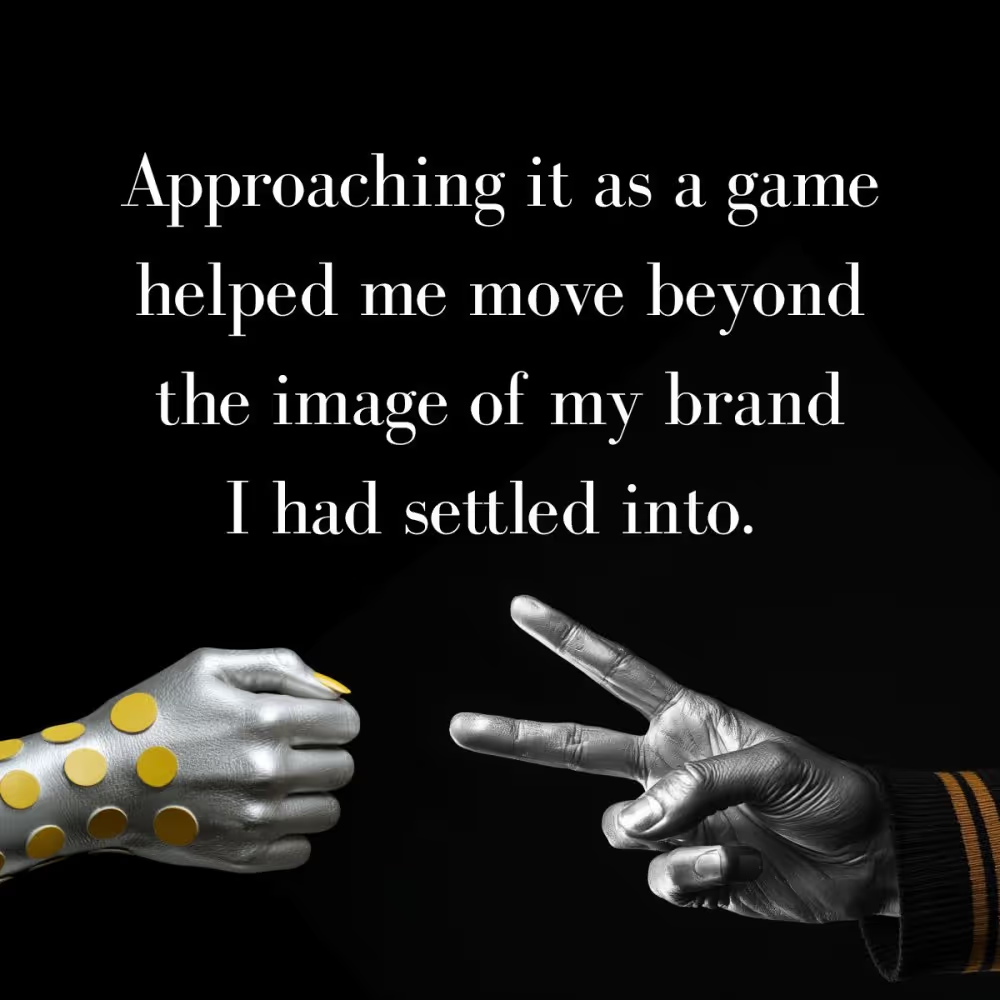
"Throughout my journey of discovering my brand, I often came across rather rigid advice. Even if technically correct, the process felt difficult and the result detached. Approaching it as a game made it easier and much more natural. It helped me move beyond the image I had settled into and uncover traits that help me stand out as a brand." Words by Olena Kitsak
We are told human attention now rivals that of a goldfish. Eight seconds and gone. And yet people binge eight episodes without moving. They scroll for an hour without noticing.
Which makes the magician's toolkit even more relevant.
Attention is a game with rules. Most people play without knowing the rules exist. Many learn the rules and begin to play with intention. They design moments carefully. They understand why a pause works, why the unexpected question opens what the expected one closes.
That's Playcraft.
And it starts, like most useful things, with paying attention to attention itself.
If this made you think, Games to Connect Your Dots has more where that came from.
If you want to work on how you hold a room — in a pitch or a client session — let's spend 90 minutes on it.