Don’t Kill the Messenger
"I kept going because I believed what I was doing is important." — Katalin Karikó, Johns Hopkins Commencement 2026
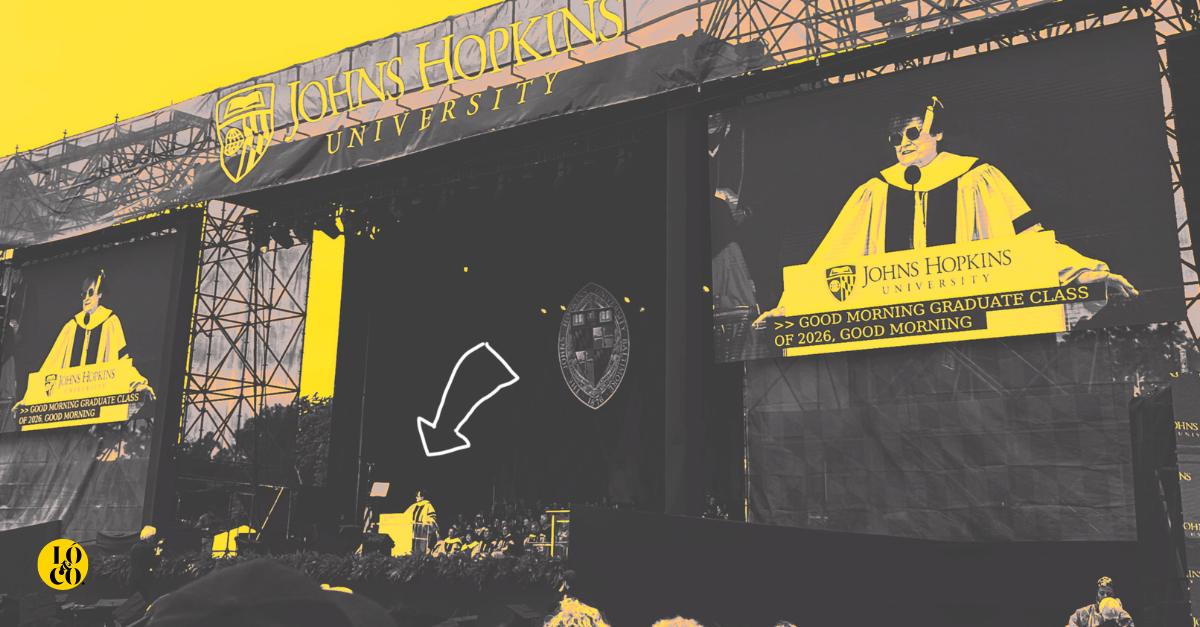
Karikó's advice to the graduates did not sound like motivational language. © Photo Myriam López
Katalin Karikó won the Nobel Prize for work that was rejected for decades. At Johns Hopkins' commencement, she spoke without inflation, without motivational language. The problem was never the message. It was how the messenger was built to travel.
Yesterday I sat in the stands at Johns Hopkins watching my daughter graduate. The commencement speaker was Katalin Karikó, the biochemist whose mRNA research helped make the COVID-19 vaccines possible.
I had no idea what to expect.
Karikó spoke with the directness of someone who had known late recognition and did not feel the need to inflate it. I was seated close to the stage, close enough to the large screens flanking it that from where I sat, she was addressing an audience of one.
And isn't that what the best public speakers do? They create intimacy in a crowd.
She began far from the Nobel stage. She grew up in a small town in Communist Hungary, in a one-room house with no running water, parents who never finished high school. A girl watching the biology of ordinary things. Plants. Animals. Eggs hatching. Seeds growing. Living things changing form.
"I didn't know a single scientist," she told the graduates. "But even then I know I will be."
Johns Hopkins President Ron Daniels introduced her by recalling those childhood days "exploring the biology of plants and animals," and described her story as a reminder that perseverance, vision, and curiosity can change the world.
Let's not use curiosity in vain.
Curiosity is easy to soften in ordinary language. We say it as though it were a personality trait, something you either have or you don't. I often use it to describe what moves me. In Karikó's life, it was the method she used to stay close to a problem after support, funding, and consensus had moved elsewhere.
Her work was rejected repeatedly. Her belief in messenger RNA did not fit what the field was ready to support. At the University of Pennsylvania, she was demoted from her research faculty position. Grants, recognition, and certainty did not arrive early.
"I kept going because I believed what I was doing is important."
She said it herself, in her first lesson to the graduates: love your work. Not work hard. Not be disciplined. Love your work. She said it because most of life is spent working, and that is a long time to be indifferent to what you are doing. But listening to her, love your work meant something more specific than finding meaning or joy in a profession. It meant what she had been doing since she was a girl watching chickens hatch from eggs and seeds push through soil. Witnessing miracles, she called it.
That is a different relationship to work than most people have, and it explains more about her path than the word perseverance ever could. Perseverance implies pushing through something you would rather not be doing. Karikó was not pushing through. She was following a question she found genuinely beautiful, when nobody else thought it was worth following.
Karikó's work centred on messenger RNA, or mRNA
Inside human cells, DNA stores genetic information. It stays inside the nucleus. When the body needs to make a protein, a section of DNA is transcribed into messenger RNA: a temporary working copy of the instruction.
That copy leaves the nucleus and travels to ribosomes, the protein-making machinery of the cell. The ribosome reads the mRNA sequence and builds the corresponding protein.
The messenger does not carry DNA out of the nucleus. It carries a copy of the instruction.
The information exists, but existence is not enough. It needs a form that can travel, be read, and become action.
Communication 101.
Karikó believed synthetic mRNA could be used in that way: as a carefully written instruction delivered to the body.
Make this protein. Recognise this threat. Prepare a response.
The implications were enormous. Viruses. Cancer. Diseases that had resisted other approaches. Instead of introducing a finished product from outside, synthetic mRNA might teach the body to make what it needed from within.
The immune system rejected the synthetic mRNA before it could deliver anything. The body treated the messenger as an intruder and destroyed it before the instruction could be read.
For most researchers, that is where the story ends. The mechanism does not cooperate, the field moves on, the funding goes elsewhere. What kept Karikó in that room was the same thing that kept her watching eggs hatch as a child. Not the outcome. The question.
Why is the body doing this? What exactly is happening at the molecular level? What would change if one thing were different?
Don't kill the messenger.
Working with Drew Weissman, a colleague she met at the department's shared copy machine, Karikó investigated the immune response and found that a modification to the molecule could suppress it. A substitution changed how the body received the messenger.
The message did not need to shout louder. It needed to arrive differently.
Negotiation 101.
Once the messenger could survive the journey, the instruction could be read. The cell could respond. The body could act.
The M in mRNA stands for Messenger. It also stands for Modified.
Years later, when SARS-CoV-2 appeared, that work became the foundation for the first mRNA vaccines approved for public use. To the world, the breakthrough seemed to arrive in the compressed time of a pandemic. In reality, it had been carried forward by decades of attention to a problem most people had stopped finding interesting.
That is the part of her story I keep returning to.
There is a line from the 1979 film Alien that may be one of the greatest copylines ever written for entertainment:
In space, no one can hear you scream.
It works because it is terrifying. It also works because it is true. Sound needs a medium. In space, there is no air for sound waves to travel through. The scream exists. The danger is real. Still, nothing arrives.
Survival 101.
A message can be true and still fail to arrive. An idea can be useful and still be rejected.
The problem may not be the message. It may be the form it travels in. It may be that what you are carrying has not yet been modified to survive the conditions it needs to pass through.
When something does not land, the instinct is to defend the message. Explain it louder. Add more evidence. Try again with the same carrier.
Karikó's story suggests a different discipline: study the failure of arrival.
Think about something you are working on right now. An idea, a project, a conversation you have had three times without being able to make a point.
Is the message the problem? Or is the messenger not yet built to survive the conditions it needs to pass through?
One modification. One different building block.
Delivery 101.
That is what the work of communication often is. Not reinvention. A small, deliberate change to how something delivers. A different word, a different frame, a different entry point, a different presenter. The idea stays intact. The instruction remains correct. The messenger gets modified until it can finally arrive.
A copy machine is a wonderfully unglamorous place for the future of medicine to begin
That is also communication. Being in the right proximity to the right question at the right time. Not everything needs a strategy. Some things need two people still interested in the same unsolved problem.
Karikó's advice to the graduates did not sound like motivational language.
She spoke about the question she had to answer for herself as a small-town Hungarian girl arriving at an Ivy League institution: could she discover something all those very smart scientists around her had not?
Her answer to herself: "Yes. Why not?"
She spoke about comparison as a drain.
"There will be people who seem to achieve more, earn more, advance faster. But that kind of comparison can drain your enthusiasm and distract you from your own passion."
Her standard was internal.
"The only meaningful comparison is to the person you were yesterday."
She spoke about setbacks plainly.
"Carry a grudge only poisons you."
Karikó had been rejected, demoted, and professionally set back. She thanked the people who supported her. She also thanked the people who made her life harder, and then added, with timing she had clearly practised:
"I didn't invite them to Stockholm."
How you respond to disappointment determines how much of your attention remains available for the work.
Resentment is expensive. So is spending a life proving people wrong. Karikó's point was not passivity. It was conservation. Keep your hours. Keep your humour. Keep the work moving.
She spoke about success as something never built alone. Her husband supported every difficult decision, never told her to stop, and fixed the benchtop centrifuge she kept bringing home broken from weekend lab sessions. Their daughter grew up inside the reality of that commitment.
"She turned out okay." Two Olympic gold medals in rowing for the United States.
To the graduating women in the stadium, she was direct: "You do not need to choose between career and having a family. Choose a partner who believes in your dreams and supports your decisions."
And to everyone else: "Be that kind."
She also told a story about her daughter coming home from second grade and sitting down immediately to write a thank-you letter to her teacher. Karikó realised at 35 she had never done the same for her own teachers.
"Do not hesitate to learn from anybody. Even a 7 year old can teach you something important."
She closed with time. Something as true for her as a new graduate fifty years ago, as it is today.
"You still have only 24 hours in a day. Use them wisely. Not everything that demands your attention deserves it."
One detail from the ceremony. In a stadium full of graduates, masters, doctors of science, deans, president, trustees, families, and one Nobel laureate at the podium, artificial intelligence came up twice.
In passing.
The speech was about attention. Work. Time. Curiosity. What you do when what you propose is not yet understood. How you respond when the messenger is rejected. Who stands beside you while you keep going.
Karikó closed simply
"Stay curious."
Then:
"Go make this world a better place for all of us."
Why not. How you respond. Who you choose.
Those three questions will determine how ___ your life will be.
This is also the work behind Ló&Co.
Curiosity is the driver. Strategy is the structure. Play is the way we make the invisible parts of a business visible enough to work with.
We slow down, look at what is not working, and sometimes we modify the messenger before rushing to change the message.
Myriam López is an award-winning creative director, former TV executive, and National Certified Pilates Teacher (NCPT). Based in Madrid and working internationally, she leads Ló&co. — business strategy through movement and play.
Something you're working on isn't delivering. Let's look at the messenger. → Ló & Easy™