Chicken Soup for Future Thinking
Behind the scenes of designing a futures game
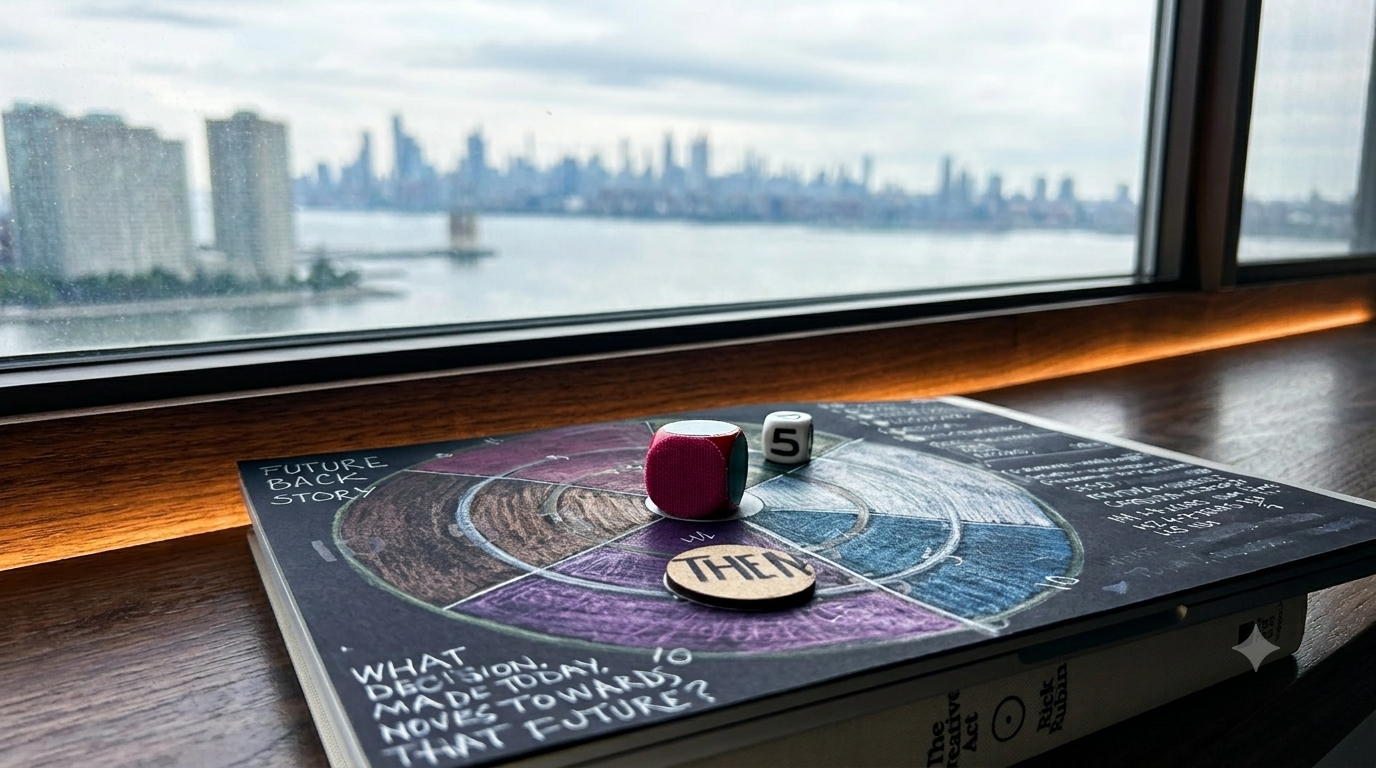
Road to Ventoria in prototype form: a futures game designed to turn uncertainty into better decisions. © Image Myriam López
The last article ended on a roll.
More precisely, with a question: what do you actually do with the roll you got when several things are changing at once?
That became the brief for a game I was creating for a design summit about the future of design.
Uncertainty has become the chicken soup of future thinking. It is served at every conference, stirred into every trend report, and prescribed for almost every problem. Markets are uncertain. Technology is uncertain. Work is uncertain. Design is uncertain. Have another bowl.
Naming the condition is easy. Designing a useful response is harder.
I wanted to make a small futures-back storytelling game that a designer, facilitator, coach, or business owner could use alone. It needed enough structure to prevent the player from staring at a blank page, enough chance to disturb the answer they arrived with, and enough play to make the future feel available rather than intimidating. Most importantly, it had to send the player back to the present with something more useful than an interesting story.
I am keeping the full mechanics inside the prototype. What interests me here is how each design decision changed the kind of thinking the game could produce.
The first version began with a backgammon board and three ideas borrowed from a thirteenth-century king of Castile.
Backgammon seemed almost suspiciously well suited to the task. It already contained movement, chance, tension, opposition, distance, and return. Its points created a visible route. The pieces made progress physical. The dice introduced what could not be planned. A player could move away from the present, encounter something unexpected, and come back with a decision.
Then the board began making its own argument.
A backgammon board is directional. However unpredictable the roll, the pieces still travel along a route. The form tells you that you are moving from here to there, toward a destination somewhere ahead.
Uncertainty rarely behaves so politely.
Change loops, stalls, doubles back, or arrives early in one area and late in another. A major trend fades into the wallpaper. Something that looked peripheral on Monday has taken over the job by Thursday. The board made movement visible, while also making the future look straighter than it is.
That shifted the problem from game design to information design.
Every representation carries an argument. A timeline says sequence. A matrix says comparison. A map says territory. A path says progress. A wheel suggests recurrence, simultaneity, and interdependence. Put the same information into a different form and the thought itself changes.
The question was no longer whether the game looked good on a backgammon board. The question was what kind of future the board was teaching the player to imagine.
So I tried a wheel.
The wheel could hold several forces at once. Different drivers of change could occupy the same field without being arranged into a neat procession. That felt closer to how change is actually experienced. A technological development may appear years away while its social consequences are already here. An environmental issue may remain visible for decades and still arrive as a sudden business constraint. A demographic shift can move gradually until a policy, product, or cultural event suddenly gives it speed.
The future is uneven, and the wheel made that unevenness easier to see.
It also created a new problem. A circle has no natural beginning or end. It can hold complexity beautifully and still leave the player revolving around it. The backgammon board gave the player a road. The wheel gave them a field.
I needed both.
The solution became a radial board divided into sectors and bands of time. The sectors held different forces shaping the future. The rings created distance. A player could move outward without being pushed along a single route.
That became one of the central lessons of the game’s development. No representation can tell the whole truth. The useful question is which distortion each form introduces, and whether the rest of the system can correct for it.
The wheel held simultaneity, and the rings held distance, but a game needs more than a clear representation.
It needs rules that create movement, mechanics that produce consequence, and enough uncertainty to prevent the player from simply confirming what they already think. Each element has to perform a distinct job, while the whole system remains simple enough to disappear once play begins.
The first version of the die carried too much information. Each face included a colour, a word, and an icon, forcing the player to interpret several signals before responding to the roll. The die only needed to select a lens, so everything except the colour was removed.
The dice introduced chance. The image supplied material. The board gave it position. Each element had one job.
This matters more than it may appear to. In facilitation and coaching, an overdesigned tool can quietly consume the attention it was meant to direct. The participant begins managing the method instead of thinking with it. A useful mechanic creates the conditions for a thought to appear, then gets out of the way.
The story prompt ran into the same problem.
An early version asked the player to fold each turn into one continuous narrative. It sounded elegant. In practice, it invited analytical thinking in too early, even though the game is designed to delay it on purpose.
That mode is already working hard all day, trying to solve the problem with the same material it has always used. If that were enough, many of the problems we keep circling would already be solved.
The game needed another way in first. Enter photographic images.
The player would draw an image, make a roll, and immediately begin explaining. Would this really happen? How did it connect to the previous idea? What evidence would support it? What would make it plausible?
The future had barely appeared before analytical thinking began closing it down. That mode is designed to resolve, organise, and reduce uncertainty. Here, I needed the opposite: enough curiosity to let an unfamiliar possibility develop before deciding what to do with it.
Present-to-future thinking usually extends what is already visible.
We begin with current conditions, add a reasonable development, then another, and eventually arrive at a future that looks remarkably like today with fewer wrinkles. The present remains both the starting point and the border.
Future-back thinking works differently.
The player travels forward first, encounters something they did not plan, and then looks back. The distance changes the question. Instead of asking what the next logical step might be, the player considers what would have to become possible for that future to exist.
The story rule became looser. The future could be specific, unexpected, personal, and slightly ridiculous. Plausibility could wait long enough for something unfamiliar to get through.
“Technology will change how we work” gives the mind almost nothing to hold. “People now hire temporary digital doubles to attend internal meetings” creates friction immediately. Who benefits? What becomes valuable? What disappears? What new etiquette appears? Who refuses? The absurd detail may be wrong while the tension inside it is exactly right.
Images became essential for the same reason.
A written prompt begins narrowing the answer before the player has started. An image is concrete but unsettled. A face on a screen, a pile of shells, an empty staircase, a hand holding something difficult to identify. The image gives the imagination somewhere to land without deciding what it means.
For designers, facilitators, and coaches, that makes images more than a creative accessory. They create a way into material that may not yet be available in language. They allow association to come before explanation, which is often where the more interesting thinking begins.
The latest version of Road to Ventoria also introduced three ways of reading change, drawn from the logic that first led me to Alfonso X and the Libro de los Juegos.
Seso follows what is already in motion. Ventura introduces disruption. Cordura looks for what has quietly begun.
Together, they prevent the game from treating the future as one kind of event. Some futures emerge through continuation. Some arrive unexpectedly. Some are already underway, still being treated as marginal, temporary, or strange.
Cordura may be the most useful of the three because people often imagine the future as something waiting somewhere later. It asks the player to look again at the present and notice what is already underfoot.
The game remains intentionally low stakes. The player is not committing a budget, presenting a strategy, or announcing a five-year plan. They are moving a token, rolling a die, drawing an image, and saying what appears.
That distance matters. Play lowers the cost of being wrong. It allows contradiction and lets someone follow an idea further than professional self-protection normally permits. It can also be enjoyable, which is not incidental. Curiosity changes the quality of attention. People notice more, defend less, and remain with an unresolved thought for longer.
Possibility, however, can become its own form of avoidance. A beautifully imagined future is still only a story until something returns with the player.
That is why the final question survived every iteration:
What decision, made today, moves toward that future?
The board does not provide the answer. The roll does not provide the plan. The images do not predict what comes next. Together, they create enough distance from the present for a different decision to become visible.
That is the part I want designers, facilitators, and coaches to care about. The form is not decoration, and the mechanics are not entertainment added after the serious thinking.
The wheel, rings, dice, images, and tokens participate in the reasoning.
Each component makes one part of the problem easier to see while introducing a distortion that another component has to correct.
The road hid simultaneity. The wheel risked hiding movement. The instructions hid surprise beneath explanation.
The game became clearer each time someone test played it.
It does not remove uncertainty.
It gives us something to do with the roll we got.
The game is still in development, but the thinking behind it already belongs to a larger way of working with uncertainty, movement, and decision-making.
The roll is not the plan. The plan is what you do with the roll you got. → Solo Futures Game