The Medium Is Still the Message
“All media work us over completely.”— Marshall McLuhan
Tomorrow's Tools. Yesterday's Concepts. A Mano a Mano of Intelligences.
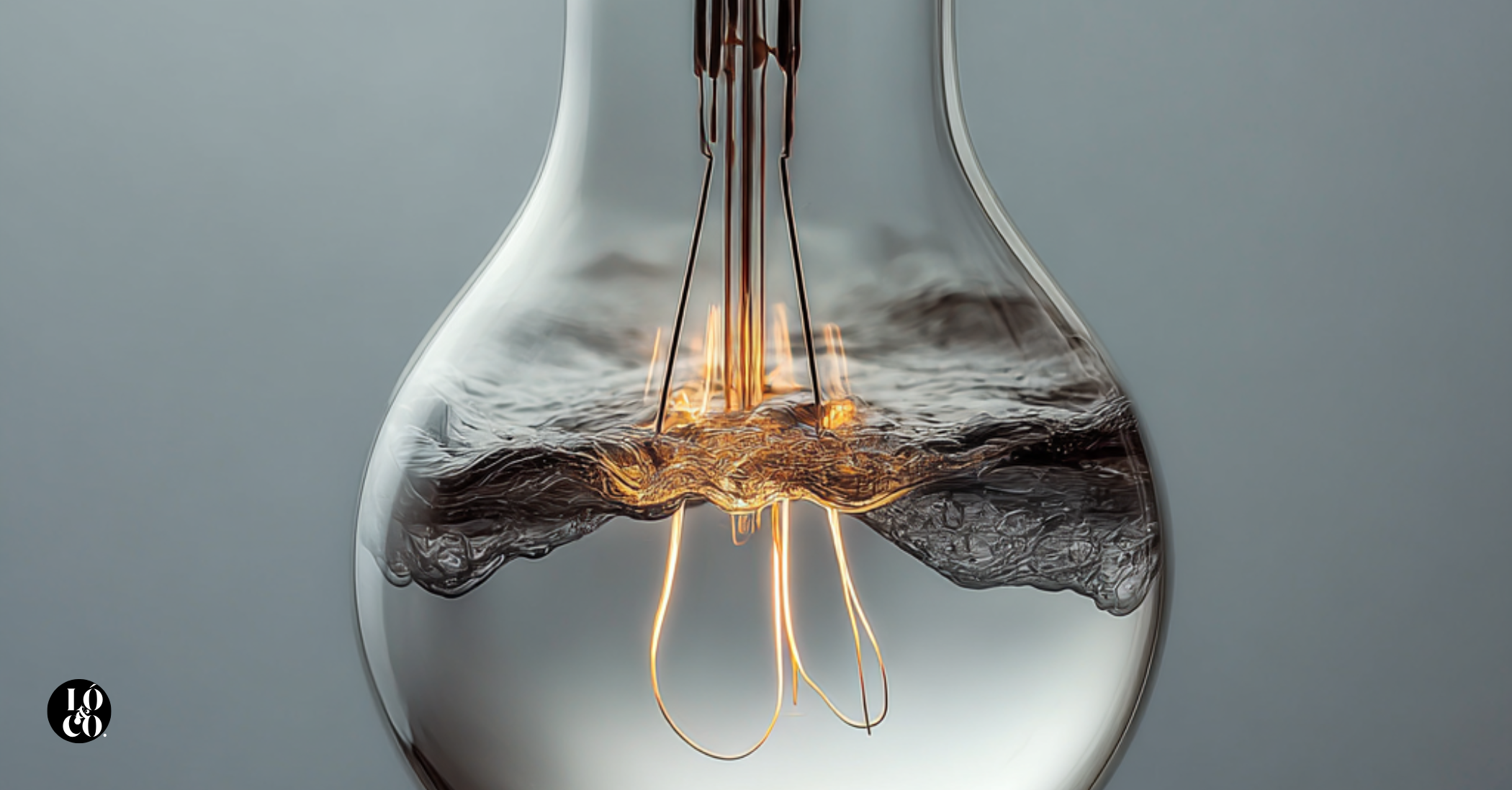
Water. Filament. Heat. Glass. Not off. Not on. Not empty. Not full. Uncertainty, and therefore possible. © Myriam López
McLuhan's point was never about content. It was that media change the conditions of thought before we realise our thinking has changed. What generative AI is doing to the sequence of creative work, and where the anxiety actually comes from.
In 1967, the year I was born and Joseph Pilates died, Marshall McLuhan published The Medium is the Massage at the moment broadcast television was reorganizing everything print had built. The pace changed. Attention changed. Thinking changed.
McLuhan's point was not that media simply carry information.
His point was that media change us.
They change the conditions of thought before we realise our thinking has changed.
For McLuhan, media and technology were the same thing. Every technology is a medium. The wheel is a medium. The printed page is a medium. Television is a medium. He wasn't talking about journalism or broadcasting specifically, he was talking about any extension of human capability.
His favourite example was the light bulb. No content. No message in the traditional sense. Just a technology that created an entirely new environment for human activity, one that restructured when people worked, gathered, and slept. The medium was the environment. The environment was the message.
That is why the old line still matters.
The medium is still the message.
And right now, the message is not only what AI produces.
It is the order in which we have started to work.
A lot of us seasoned-to-perfection designers have lived through several reorganizations already.
We went from paste-up boards to QuarkXPress to InDesign to Canva. We survived the internet, social media, responsive design, mobile-first, and creatives are becoming obsolete and we are all going to lose our jobs.
Somehow, every era believed it was Armageddon.
And yet, here we are.
Mostly because Command Z still works.
Some things are sacred.
Tomorrow's tools. Yesterday's concepts.
McLuhan wrote that anxiety is, in great part, the result of trying to do today's job with yesterday's tools and yesterday's concepts.
Let's adjust that thought to today's challenge.
We are trying to do today's job with tomorrow's tools and yesterday's concepts.
The tools have moved ahead. Way too fast. We are only beginning to understand that what needs adjusting is not the workflow. It is the way we think. And that goes way beyond the prompt.
For centuries, society was ready before the tools were. The desire for personal independence existed long before the cordless phone. The need to connect existed long before the internet. Tools arrived to meet a human need that was already waiting.
Now the tools arrive before the need has formed. Before we know what question we're asking. Before we've decided what problem we're trying to solve. That is a different kind of problem entirely.
And this is where my anxiety starts creeping in.
Let me show you a moment when AI saved the day.
English is a language I love, but not my first and finding my tone in it has been a debilitating marathon. When generative AI arrived, I spent hours training ChatGPT, Gemini, and eventually Claude toward what felt like a good balance between the way I sound and the way I wanted to write. Suddenly, I could do it with polished grammar and vocabulary working to my advantage.
At first, I was awestruck by my new ability to sound like everyone else.
I told my mother, who has always been game for scientific advancements, that maybe one day I could train AI to become another brain.
I take that back for now.
A mano a mano of intelligences
There is a mano a mano of intelligences happening in this article. Mine and Claude's. I noticed that Claude's unscripted reasoning voice (reactive, thinking out loud, no time to be clever ) is closer to how I actually sound than the writing it produces when given time to perform. I told Claude. Claude agreed immediately. Which made me wonder who was training whom.
Turns out I also out-stayed its memory. At some point in a long conversation, Claude starts dropping confirmed decisions. Reverting to earlier versions. Forgetting what was locked.
It started to behave more like humans.
If you have ever quit a habit, you know this already: the craving does not vanish, but your relationship to it changes.
You start catching it earlier. There is usually a small gap there, enough space to pause, breathe, and choose not to hand the steering wheel over right away.
And then the draft arrives.
You type a few words and suddenly there is a paragraph, a campaign, a strategy, a tone of voice, a logo direction, a business plan.
You stop breathing, not enough space to think.
The strange part is not how fast AI can produce good enough content, but how quickly we reorganize ourselves around the fact that it does.
The blank page used to stay blank long enough to argue with yourself.
Now it answers back immediately.
Because when something plausible appears too soon, relief can start feeling like a good habit to have.
The tyranny of the adequate first draft
Not terrible enough to reject. Not meaningful enough to believe. Just convincing enough.
Uncertainty used to be built into the process. You had to sit with it longer. Ideas needed time to contradict themselves before becoming useful. Now that relationship is changing.
We move faster toward resolution. Sometimes before we've understood the problem.
There is something physical about that moment. You can feel it. The compression. The acceleration. The low-grade urgency of needing to respond before fully processing.
Creative work is beginning to feel similar. The difficult work becomes staying present long enough to know what you actually think.
Maybe the anxiety is not a sign that we are failing to keep up.
Maybe it is that feeling during spring when you have just stored away the winter clothing and a cold spell hits again.
Everyone has been there. The question is what you do next
If uncertainty is no longer optional, what exactly are we doing when we design/create/work?
One last thing before you go.
What would you take to the moon?
Strip it down. What's essential. What's symbolic.
That's one card from a 25-card deck designed to unlearn your thinking and play with uncertainty as a given.
Disrupt. Unthink. Reimagine.
If you're curious, there's more where that came from.
Myriam López is an award-winning creative director, former TV executive, and National Certified Pilates Teacher (NCPT). Based in Madrid and working internationally, she leads Ló&co. business strategy shaped like play.
Uncertainty is not the problem. Not knowing what to do with it is.